Friday, December 05, 2008
7:28 PM ● Bermuda Triangle
Bermuda Triangle The infamous ‘Bermuda Triangle’ is a region located in the northwestern Atlantic Ocean. It is one of the two places on earth where a compass will not point to true, magnetic north. A lot of people hold that the laws of physics do not apply here! Over the course of several years, Bermuda Triangle has devoured so many aircrafts and ships passing through it that it has come to be called the ‘Devil’s Triangle’. A lot has been said and written about it. Numerous documentaries attempting to investigate the Bermuda Triangle have been made and screened. What resulted as consequence is a mix of facts, theories, mysteries and myths associated with the infamous Bermuda Triangle. But, never one solid consistent explanation! So read to apprise yourself about different aspects of the Bermuda Triangle. Bermuda Triangle Interesting Facts Location - The Bermuda Triangle or the Devil’s Triangle is located around the east coast of Florida and Peurto Rico. A little portion of this triangle also spills into the area next to South Carolina. Absolute Location – Spread over a huge body of water in the Atlantic Ocean, the Bermuda Triangle does not possess a definite absolute location. But it can be said to lie in-between 80-90 degrees west and 30-20 degrees north. Bermuda Triangle is infamous For - Over 66 airplanes and ships passing through the Bermuda Triangle have been known to have got sucked into down forever. No information was derived about them. The most notorious disappearance was that of an airplane by the name ‘Flight 19’. It disappeared some 30 years ago and has not been seen since. Description - The Bermuda Triangle is a windy, but sunny region. Winds blowing over the region have a speed of around 10 miles m.p.h. The region does not have distinct seasons. Bermuda Triangle Mystery & Myths More than a 100 separate mysterious disappearances of aircrafts and ships are known to have occurred in the Bermuda Triangle region. Some really gigantic vessels like the USS Cyclops and the SS Marine Sulphur Queen have got lost in it. Famous Italian explorer, Christopher Columbus jotted down many gripping recordings in his dairy during his journey of the Devil's Triangle in 1492. He mentioned about weird magnetic deviances in his navigation instruments. Unusual lights were noticed on the horizon. The Italian explorer has also talked about a ‘great flame of fire’ in his writings that crashed into the ocean. A mysterious episode took place in 1872. A vessel ‘Mary Celeste’ had left for Genoa on 7 November 1872. On 4 December 1872, the crew on the Dei Gratia spotted this vessel and was alarmed by how randomly it was sailing. When they approached the ship, they found it entirely vacant. Even the lifeboat was not to be found despite the fact that the ship was otherwise in perfect condition. The vanishing of Flight 19 tops the Bermuda Triangle collection of myths and mysteries. On 5 December 1945, five Navy Avengers went missing while on a standard training mission in the Atlantic. The patrol leader, Lt. Charles Taylor had radioed Florida the following strange message - "Control tower this is an emergency. We seem to be off course. We seem to be lost. We can't make out where we are". When instructed to turn the ship towards the west, he replied "Everything looks wrong, even the ocean looks strange". A Navy search was set out into the Atlantic that went on for weeks, but no trace was ever found of the aircraft or crew. The search team included a Martin Mariner, which blew up just after 23 minutes into its flight. On 27 December 1948, a commercial flight flying from Puerto Rico towards Florida met with a similar fate. NC-16002 DC-3 radioed Miami that they were 50 miles out and all set to accept landing instructions. After Miami radioed back the instructions, it waited for a reply of confirmation but none came. After three hours, a search and rescue team was dispatched to trace the missing aircraft. No trace, what so ever, was found! Bermuda Triangle Theories A lot of authors, who have written on the Bermuda Triangle, have put forward supernatural theories to explain the disappearance of various ships and places in this region. One such explanation theory for Bermuda Triangle episode puts blame on leftover technology from the lost continent of Atlantis. At times the submerged rock formation called ‘Bimini Road’ off the island of Bimini in the Bahamas is linked to the Atlantis story. The Bimini Road is believed to exist within the Bermuda Triangle as per some theories. There are other writers about the Bermuda Triangle who associate the events to UFOs. This idea was used in the Hollywood film ‘Close Encounters of the Third Kind’ by famous director Steven Spielberg. It features the lost ‘Flight 19’ as being abducted by the aliens. Charles Berlitz, the grandson of an illustrious linguist and author of many additional books on anomalous phenomena, too has commented on these extraordinary events. He has explained the losses in the Devil’s Triangle to anomalous or unexplained forces. The Triangle area The boundaries of the Triangle vary with the author; some stating its shape is akin to a trapezoid covering the Straits of Florida, the Bahamas and the entire Caribbean island area and the Atlantic east to the Azores; others add to it the Gulf of Mexico. The more familiar, triangular boundary in most written works has as its points somewhere on the Atlantic coast of Florida; San Juan, Puerto Rico; and the mid-Atlantic island of Bermuda, with most of the accidents concentrated along the southern boundary around the Bahamas and the Florida Straits.  The area of the Triangle varies by author. The area is one of the most heavily-sailed shipping lanes in the world, with ships crossing through it daily for ports in the Americas, Europe, and the Caribbean Islands. Cruise ships are also plentiful, and pleasure craft regularly go back and forth between Florida and the islands. It is also a heavily flown route for commercial and private aircraft heading towards Florida, the Caribbean and South America from points north. The Gulf Stream ocean current flows through the Triangle after leaving the Gulf of Mexico; its current of five to six knots may have played a part in a number of disappearances. Sudden storms can and do appear, and in the summer to late fall hurricanes strike the area. The combination of heavy maritime traffic and tempestuous weather makes it inevitable that vessels could founder in storms and be lost without a trace – especially before improved telecommunications, radar and satellite technology arrived late in the 20th century.[5]
History of the Triangle story According to the Triangle authors, Christopher Columbus was the first person to document something strange in the Triangle, reporting that he and his crew observed "strange dancing lights on the horizon", flames in the sky, and at another point he wrote in his log about bizarre compass bearings in the area. From his log book, dated October 11, 1492 he wrote:[6] "The land was first seen by a sailor (Rodrigo de Triana), although the Admiral at ten o'clock that evening standing on the quarter-deck saw a light, but so small a body that he could not affirm it to be land; calling to Pero Gutiérrez, groom of the King's wardrobe, he told him he saw a light, and bid him look that way, which he did and saw it; he did the same to Rodrigo Sánchez of Segovia, whom the King and Queen had sent with the squadron as comptroller, but he was unable to see it from his situation. The Admiral again perceived it once or twice, appearing like the light of a wax candle moving up and down, which some thought an indication of land. But the Admiral held it for certain that land was near..." Modern scholars checking the original log books have surmised that the lights he saw were the cooking fires of Taino natives in their canoes or on the beach; the compass problems were the result of a false reading based on the movement of a star.[citation needed] The first article of any kind in which the legend of the Triangle began appeared in newspapers by E.V.W. Jones on September 16, 1950, through the Associated Press.[7] Two years later, Fate magazine published "Sea Mystery At Our Back Door" [8], a short article by George X. Sand covering the loss of several planes and ships, including the loss of Flight 19, a group of five U.S. Navy TBM Avenger bombers on a training mission. Sand's article was the first to lay out the now-familiar triangular area where the losses took place. Flight 19 alone would be covered in the April 1962 issue of American Legion Magazine.[9] It was claimed that the flight leader had been heard saying "We are entering white water, nothing seems right. We don't know where we are, the water is green, no white." It was also claimed that officials at the Navy board of inquiry stated that the planes "flew off to Mars." This was the first article to connect the supernatural to Flight 19, but it would take another author, Vincent Gaddis, writing in the February 1964 Argosy magazine to take Flight 19 together with other mysterious disappearances and place it under the umbrella of a new catchy name: "The Deadly Bermuda Triangle";[10] he would build on that article with a more detailed book, Invisible Horizons, the next year.[11] Others would follow with their own works: John Wallace Spencer (Limbo of the Lost, 1969, repr. 1973) [12]; Charles Berlitz (The Bermuda Triangle, 1974)[13]; Richard Winer (The Devil's Triangle, 1974) [14], and many others, all keeping to some of the same supernatural elements outlined by Eckert.[15]
Kusche's explanation Lawrence David Kusche, a research librarian from Arizona State University and author of The Bermuda Triangle Mystery: Solved (1975)[16] has challenged this trend. Kusche's research revealed a number of inaccuracies and inconsistencies between Berlitz's accounts and statements from eyewitnesses, participants, and others involved in the initial incidents. He noted cases where pertinent information went unreported, such as the disappearance of round-the-world yachtsman Donald Crowhurst, which Berlitz had presented as a mystery, despite clear evidence to the contrary. Another example was the ore-carrier Berlitz recounted as lost without trace three days out of an Atlantic port when it had been lost three days out of a port with the same name in the Pacific Ocean. Kusche also argued that a large percentage of the incidents which have sparked the Triangle's mysterious influence actually occurred well outside it. Often his research was surprisingly simple: he would go over period newspapers and see items like weather reports that were never mentioned in the stories. Kusche came to a conclusion: - The number of ships and aircraft reported missing in the area was not significantly greater, proportionally speaking, than in any other part of the ocean.
- In an area frequented by tropical storms, the number of disappearances that did occur were, for the most part, neither disproportionate, unlikely, nor mysterious; furthermore, Berlitz and other writers would often fail to mention such storms.
- The numbers themselves had been exaggerated by sloppy research. A boat listed as missing would be reported, but its eventual (if belated) return to port may not have been reported.
- Some disappearances had in fact, never happened. One plane crash was said to have taken place in 1937 off Daytona Beach, Florida, in front of hundreds of witnesses; a check of the local papers revealed nothing.
Kusche concluded that: - The Legend of the Bermuda Triangle is a manufactured mystery… perpetuated by writers who either purposely or unknowingly made use of misconceptions, faulty reasoning, and sensationalism. [16] §Epilogue, p. 277
Other responses The marine insurer Lloyd's of London has determined the Triangle to be no more dangerous than any other area of ocean, and does not charge unusual rates for passage through the region. United States Coast Guard records confirm their conclusion. In fact, the number of supposed disappearances is relatively insignificant considering the number of ships and aircraft which pass through on a regular basis. The Coast Guard is also officially skeptical of the Triangle, noting that they collect and publish, through their inquiries, much documentation[17] contradicting many of the incidents written about by the Triangle authors. In one such incident involving the 1972 explosion and sinking of the tanker V.A. Fogg in the Gulf of Mexico, the Coast Guard photographed the wreck and recovered several bodies[18], in contrast with one Triangle author's claim that all the bodies had vanished, with the exception of the captain, who was found sitting in his cabin at his desk, clutching a coffee cup. [12] The NOVA / Horizon episode The Case of the Bermuda Triangle (1976-06-27) was highly critical, stating that "When we've gone back to the original sources or the people involved, the mystery evaporates. Science does not have to answer questions about the Triangle because those questions are not valid in the first place. ... Ships and planes behave in the Triangle the same way they behave everywhere else in the world."[19] Skeptical researchers, such as Ernest Taves[20] and Barry Singer[21], have noted how mysteries and the paranormal are very popular and profitable. This has led to the production of vast amounts of material on topics such as the Bermuda Triangle. They were able to show that some of the pro-paranormal material is often misleading or inaccurate, but its producers continue to market it. Accordingly, they have claimed that the market is biased in favour of books, TV specials, etc. which support the Triangle mystery, and against well-researched material if it espouses a skeptical viewpoint. Finally, if the Triangle is assumed to cross land, such as parts of Puerto Rico, the Bahamas, or Bermuda itself, there is no evidence for the disappearance of any land-based vehicles or persons. The city of Freeport, located inside the Triangle, operates a major shipyard and an airport which annually handles 50,000 flights, and is visited by over a million tourists a year.
Natural explanations
Methane hydrates -
 Worldwide distribution of confirmed or inferred offshore gas hydrate-bearing sediments, 1996. Source: USGS 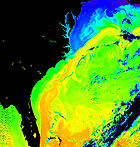 False-color image of the Gulf Stream flowing north through the western Atlantic Ocean. (NASA) An explanation for some of the disappearances has focused on the presence of vast fields of methane hydrates on the continental shelves. Laboratory experiments carried out in Australia have proven that bubbles can, indeed, sink a scale model ship by decreasing the density of the water[22]; any wreckage consequently rising to the surface would be rapidly dispersed by the Gulf Stream. It has been hypothesized that periodic methane eruptions (sometimes called "mud volcanoes") may produce regions of frothy water that are no longer capable of providing adequate buoyancy for ships. If this were the case, such an area forming around a ship could cause it to sink very rapidly and without warning. A white paper was published in 1981 by the United States Geological Survey about the appearance of hydrates in the Blake Ridge area, off the southeastern United States coast.[23] However, according to a USGS web page, no large releases of gas hydrates are believed to have occurred in the Bermuda Triangle for the past 15,000 years.[24]
Compass variations Compass problems are one of the cited phrases in many Triangle incidents. Some have theorized the possibility of unusual local magnetic anomalies in the area, however these have not been shown to exist. It should also be remembered that compasses have natural magnetic variations in relation to the Magnetic poles. For example, in the United States the only places where magnetic (compass) north and geographic (true) north are exactly the same are on a line running from Wisconsin to the Gulf of Mexico. Navigators have known this for centuries. But the public may not be as informed and think there is something mysterious about the compass "changing" across an area as large as the Triangle, which it naturally will.
Hurricanes Hurricanes are powerful storms which are spawned in tropical waters, and have historically been responsible for thousands of lives lost and billions of dollars in damage. The sinking of Francisco de Bobadilla's Spanish fleet in 1502 was the first recorded instance of a destructive hurricane. These storms have in the past caused a number of incidents related to the Triangle.
Gulf Stream The Gulf Stream is an ocean current that originates in the Gulf of Mexico, and then through the Straits of Florida, into the North Atlantic. In essence, it is a river within an ocean, and like a river, it can and does carry floating objects. A small plane making a water landing or a boat having engine trouble will be carried away from its reported position by the current, as happened to the cabin cruiser Witchcraft on December 22, 1967, when it reported engine trouble near the Miami buoy marker one mile (1.6 km) from shore, but was not there when a Coast Guard cutter arrived.
Freak waves -
Extremely large waves can appear seemingly at random, even in calm seas. One such rogue wave caused the Ocean Ranger, then the world's largest offshore platform, to capsize off the coast of Newfoundland in 1982. There is, however, no particular reason to believe rogue waves are more common in the Bermuda region, and this explanation cannot account for the loss of airplanes.
Acts of man
Human error One of the most cited explanations in official inquiries as to the loss of any aircraft or vessel is human error. Whether deliberate or accidental, humans have been known to make mistakes resulting in catastrophe, and losses within the Bermuda Triangle are no exception. For example, the Coast Guard cited a lack of proper training for the cleaning of volatile benzene residue as a reason for the loss of the tanker V.A. Fogg in 1972. Human stubbornness may have caused businessman Harvey Conover to lose his sailing yacht, the Revonoc, as he sailed into the teeth of a storm south of Florida on January 1, 1958. Many losses remain inconclusive due to the lack of wreckage which could be studied, a fact cited on many official reports.
Deliberate acts of destruction This can fall into two categories: acts of war, and acts of piracy. Records in enemy files have been checked for numerous losses; while many sinkings have been attributed to surface raiders or submarines during the World Wars and documented in the various command log books, many others which have been suspected as falling in that category have not been proven; it is suspected that the loss of USS Cyclops in 1918, as well as her sister ships Proteus and Nereus in World War II, were attributed to submarines, but no such link has been found in the German records. Piracy, as defined by the taking of a ship or small boat on the high seas, is an act which continues to this day. While piracy for cargo theft is more common in the western Pacific and Indian oceans, drug smugglers do steal pleasure boats for smuggling operations, and may have been involved in crew and yacht disappearances in the Caribbean. Historically famous pirates of the Caribbean (where piracy was common from about 1560 to the 1760s) include Edward Teach (Blackbeard) and Jean Lafitte. Lafitte is sometimes said to be a Triangle victim himself. Another form of pirate operated on dry land. Bankers or wreckers would shine a light on shore to misdirect ships, which would then founder on the shore; the wreckers would then help themselves to the cargo. It is possible that these wreckers also killed any crew who protested. Nags Head, North Carolina, was named for the wreckers' practice of hanging a lantern on the head of a hobbled horse as it walked along the beach.
Popular theories Triangle writers have used a number of supernatural theories to explain the events. One explanation pins the blame on leftover technology from the mythical lost continent of Atlantis. Sometimes connected to the Atlantis story is the submerged rock formation known as the Bimini Road off the island of Bimini in the Bahamas, which is in the Triangle by some definitions. Followers of the purported psychic Edgar Cayce take his prediction that evidence of Atlantis would be found in 1968 as referring to the discovery of the Bimini Road. Believers describe the formation as a road, wall, or other structure, though geologists consider it to be of natural origin.[25] Other writers attribute the events to UFOs. This idea was used by Steven Spielberg for his film Close Encounters of the Third Kind, which features the lost Flight 19 as alien abductees. Charles Berlitz, grandson of a distinguished linguist and author of various additional books on anomalous phenomena, has kept in line with this extraordinary explanation, and attributed the losses in the Triangle to anomalous or unexplained forces. [13]
Famous incidents -
Flight 19  US Navy TBF Grumman Avenger flight, similar to Flight 19. This photo had been used by various Triangle authors to illustrate Flight 19 itself. (US Navy) -
Flight 19 was a training flight of TBM Avenger bombers that went missing on December 5, 1945 while over the Atlantic. The impression is given that the flight encountered unusual phenomena and anomalous compass readings, and that the flight took place on a calm day under the supervision of an experienced pilot, Lt. Charles Carroll Taylor. Adding to the intrigue is that the Navy's report of the accident was ascribed to "causes or reasons unknown." It is believed that Taylor's mother wanted to save her son's reputation, so she made them write "reasons unknown" when actually Taylor was 50 km NW from where he thought he was. [26] While the basic facts of this version of the story are essentially accurate, some important details are missing. The weather was becoming stormy by the end of the incident; only Taylor had any significant flying time, but he was not familiar with the south Florida area and had a history of getting lost in flight, having done so three times during World War II, and being forced to ditch his planes twice into the water; and naval reports and written recordings of the conversations between Taylor and the other pilots of Flight 19 do not indicate magnetic problems.[26]
Mary Celeste The mysterious abandonment in 1872 of the Mary Celeste is often but inaccurately connected to the Triangle, the ship having been abandoned off the coast of Portugal. The event is possibly confused with the sinking of a ship with a similar name, the Mari Celeste, off the coast of Bermuda on September 13, 1864. [27] Kusche noted that many of the "facts" about this incident were actually about the Marie Celeste, the fictional ship from Arthur Conan Doyle's short story "J. Habakuk Jephson's Statement" (based on the real Mary Celeste incident, but fictionalised).
Ellen Austin The Ellen Austin supposedly came across an abandoned derelict, placed on board a prize crew, and attempted to sail with it to New York in 1881. According to the stories, the derelict disappeared; others elaborating further that the derelict reappeared minus the prize crew, then disappeared again with a second prize crew on board. A check of Lloyd's of London records proved the existence of the Meta, built in 1854; in 1880 the Meta was renamed Ellen Austin. There are no casualty listings for this vessel, or any vessel at that time, that would suggest a large number of missing men placed on board a derelict which later disappeared.[28]
USS Cyclops -
The incident resulting in the single largest loss of life in the history of the US Navy not related to combat occurred when USS Cyclops under the command of Lt Cdr G. W. Worley, went missing without a trace with a crew of 309 sometime after March 4, 1918, after departing the island of Barbados. Although there is no strong evidence for any theory, storms, capsizing and enemy activity have all been suggested as explanations.[29][30]
Theodosia Burr Alston -
Theodosia Burr Alston was the daughter of former United States Vice President Aaron Burr. Her disappearance has been cited at least once in relation to the Triangle. [31] She was a passenger on board the Patriot, which sailed from Charleston, South Carolina to New York City on December 30, 1812, and was never heard from again. Both piracy and the War of 1812 have been posited as explanations, as well as a theory placing her in Texas, well outside the Triangle.
Spray -
Captain Joshua Slocum's skill as a mariner was beyond argument; he was the first man to sail around the world solo. In 1909, in his boat Spray he set out on a course to take him through the Caribbean to Venezuela. He disappeared; there was no evidence he was even in the Triangle when Spray was lost. It was assumed he was run down by a steamer or struck by a whale, the Spray being too sound a craft and Slocum too experienced a mariner for any other cause to be considered likely, and in 1924 he was declared legally dead. While a mystery, there is no known evidence of paranormal activity.
Carroll A. Deering -
A five-masted schooner built in 1919, the Carroll A. Deering was found hard aground and abandoned at Diamond Shoals, near Cape Hatteras, North Carolina on January 31, 1921. Rumors and more at the time indicated the Deering was a victim of piracy, possibly connected with the illegal rum-running trade during Prohibition, and possibly involving another ship, S.S. Hewitt, which disappeared at roughly the same time. Just hours later, an unknown steamer sailed near the lightship along the track of the Deering, and ignored all signals from the lightship. It is speculated that the Hewitt may have been this mystery ship, and possibly involved in the Deering crew's disappearance.[32]
Douglas DC-3 -
On December 28, 1948, a Douglas DC-3 aircraft, number NC16002, disappeared while on a flight from San Juan, Puerto Rico, to Miami. No trace of the aircraft or the 32 people onboard was ever found. From the documentation compiled by the Civil Aeronautics Board investigation, a possible key to the plane's disappearance was found, but barely touched upon by the Triangle writers: the plane's batteries were inspected and found to be low on charge, but ordered back into the plane without a recharge by the pilot while in San Juan. Whether or not this led to complete electrical failure will never be known. However, since piston-engined aircraft rely upon magnetos to provide spark to their cylinders rather than a battery powered ignition coil system, this theory is not strongly convincing.[33]
Star Tiger and Star Ariel -
These Avro Tudor IV passenger aircraft disappeared without trace en route to Bermuda and Jamaica, respectively. Star Tiger was lost on January 30, 1948 on a flight from the Azores to Bermuda. Star Ariel was lost on January 17, 1949, on a flight from Bermuda to Kingston, Jamaica. Neither aircraft gave out a distress call; in fact, their last messages were routine. A possible clue to their disappearance was found in the mountains of the Andes in 1998: the Star Dust, an Avro Lancastrian airliner run by the same airline, had disappeared on a flight from Buenos Aires, Argentina, to Santiago, Chile on August 2, 1947. The plane's remains were discovered at the melt end of a glacier, suggesting that either the crew did not pay attention to their instruments, suffered an instrument failure or did not allow for headwind effects from the jetstream on the way to Santiago when it hit a mountain peak, with the resulting avalanche burying the remains and incorporating it into the glacier. However, this is mere speculation with regard to the Star Tiger and Star Ariel, pending the recovery of the aircraft. It should be noted that the Star Tiger was flying at a height of just 2,000 feet (610 m), which would have meant that if the plane was forced down, there would have been no time to send out a distress message. It is also far too low for the jetstream or any other high-altitude wind to have any effect.[34]
KC-135 Stratotankers On August 28, 1963 a pair of U.S. Air Force KC-135 Stratotanker aircraft collided and crashed into the Atlantic. The Triangle version (Winer, Berlitz, Gaddis [14][13][10]) of this story specifies that they did collide and crash, but there were two distinct crash sites, separated by over 160 miles (260 km) of water. However, Kusche's research[16] showed that the unclassified version of the Air Force investigation report stated that the debris field defining the second "crash site" was examined by a search and rescue ship, and found to be a mass of seaweed and driftwood tangled in an old buoy.
SS Marine Sulphur Queen -
SS Marine Sulphur Queen, a T2 tanker converted from oil to sulfur carrier, was last heard from on February 4, 1963 with a crew of 39 near the Florida Keys. Marine Sulphur Queen was the first vessel mentioned in Vincent Gaddis' 1964 Argosy Magazine article,[10] but he left it as having "sailed into the unknown", despite the Coast Guard report which not only documented the ship's badly-maintained history, but declared that it was an unseaworthy vessel that should never have gone to sea.[35][36]
Raifuku Maru One of the more famous incidents in the Triangle took place in 1921 (some say a few years later), when the Japanese vessel Raifuku Maru (sometimes misidentified as Raikuke Maru) went down with all hands after sending a distress signal which allegedly said "Danger like dagger now. Come quick!", or "It's like a dagger, come quick!" This has led writers to speculate on what the "dagger" was, with a waterspout being the likely candidate (Winer). In reality the ship was nowhere near the Triangle, nor was the word "dagger" a part of the ship's distress call ("Now very danger. Come quick."); having left Boston for Hamburg, Germany, on April 21, 1925, she got caught in a severe storm and sank in the North Atlantic with all hands while another ship, RMS Homeric, attempted an unsuccessful rescue.[37]
Connemara IV A pleasure yacht found adrift in the Atlantic south of Bermuda on September 26, 1955; it is usually stated in the stories (Berlitz, Winer [13][14]) that the crew vanished while the yacht survived being at sea during three hurricanes. The 1955 Atlantic hurricane season lists only one storm coming near Bermuda towards the end of August, hurricane "Edith"; of the others, "Flora" was too far to the east, and "Katie" arrived after the yacht was recovered. It was confirmed that the Connemara IV was empty and in port when "Edith" may have caused the yacht to slip her moorings and drift out to sea.[citation needed]
|
about
profile
name
likes
dislikes
wishlist
all about you
|
|
Friday, December 05, 2008
7:28 PM ● Bermuda Triangle
Bermuda Triangle The infamous ‘Bermuda Triangle’ is a region located in the northwestern Atlantic Ocean. It is one of the two places on earth where a compass will not point to true, magnetic north. A lot of people hold that the laws of physics do not apply here! Over the course of several years, Bermuda Triangle has devoured so many aircrafts and ships passing through it that it has come to be called the ‘Devil’s Triangle’. A lot has been said and written about it. Numerous documentaries attempting to investigate the Bermuda Triangle have been made and screened. What resulted as consequence is a mix of facts, theories, mysteries and myths associated with the infamous Bermuda Triangle. But, never one solid consistent explanation! So read to apprise yourself about different aspects of the Bermuda Triangle. Bermuda Triangle Interesting Facts Location - The Bermuda Triangle or the Devil’s Triangle is located around the east coast of Florida and Peurto Rico. A little portion of this triangle also spills into the area next to South Carolina. Absolute Location – Spread over a huge body of water in the Atlantic Ocean, the Bermuda Triangle does not possess a definite absolute location. But it can be said to lie in-between 80-90 degrees west and 30-20 degrees north. Bermuda Triangle is infamous For - Over 66 airplanes and ships passing through the Bermuda Triangle have been known to have got sucked into down forever. No information was derived about them. The most notorious disappearance was that of an airplane by the name ‘Flight 19’. It disappeared some 30 years ago and has not been seen since. Description - The Bermuda Triangle is a windy, but sunny region. Winds blowing over the region have a speed of around 10 miles m.p.h. The region does not have distinct seasons. Bermuda Triangle Mystery & Myths More than a 100 separate mysterious disappearances of aircrafts and ships are known to have occurred in the Bermuda Triangle region. Some really gigantic vessels like the USS Cyclops and the SS Marine Sulphur Queen have got lost in it. Famous Italian explorer, Christopher Columbus jotted down many gripping recordings in his dairy during his journey of the Devil's Triangle in 1492. He mentioned about weird magnetic deviances in his navigation instruments. Unusual lights were noticed on the horizon. The Italian explorer has also talked about a ‘great flame of fire’ in his writings that crashed into the ocean. A mysterious episode took place in 1872. A vessel ‘Mary Celeste’ had left for Genoa on 7 November 1872. On 4 December 1872, the crew on the Dei Gratia spotted this vessel and was alarmed by how randomly it was sailing. When they approached the ship, they found it entirely vacant. Even the lifeboat was not to be found despite the fact that the ship was otherwise in perfect condition. The vanishing of Flight 19 tops the Bermuda Triangle collection of myths and mysteries. On 5 December 1945, five Navy Avengers went missing while on a standard training mission in the Atlantic. The patrol leader, Lt. Charles Taylor had radioed Florida the following strange message - "Control tower this is an emergency. We seem to be off course. We seem to be lost. We can't make out where we are". When instructed to turn the ship towards the west, he replied "Everything looks wrong, even the ocean looks strange". A Navy search was set out into the Atlantic that went on for weeks, but no trace was ever found of the aircraft or crew. The search team included a Martin Mariner, which blew up just after 23 minutes into its flight. On 27 December 1948, a commercial flight flying from Puerto Rico towards Florida met with a similar fate. NC-16002 DC-3 radioed Miami that they were 50 miles out and all set to accept landing instructions. After Miami radioed back the instructions, it waited for a reply of confirmation but none came. After three hours, a search and rescue team was dispatched to trace the missing aircraft. No trace, what so ever, was found! Bermuda Triangle Theories A lot of authors, who have written on the Bermuda Triangle, have put forward supernatural theories to explain the disappearance of various ships and places in this region. One such explanation theory for Bermuda Triangle episode puts blame on leftover technology from the lost continent of Atlantis. At times the submerged rock formation called ‘Bimini Road’ off the island of Bimini in the Bahamas is linked to the Atlantis story. The Bimini Road is believed to exist within the Bermuda Triangle as per some theories. There are other writers about the Bermuda Triangle who associate the events to UFOs. This idea was used in the Hollywood film ‘Close Encounters of the Third Kind’ by famous director Steven Spielberg. It features the lost ‘Flight 19’ as being abducted by the aliens. Charles Berlitz, the grandson of an illustrious linguist and author of many additional books on anomalous phenomena, too has commented on these extraordinary events. He has explained the losses in the Devil’s Triangle to anomalous or unexplained forces. The Triangle area The boundaries of the Triangle vary with the author; some stating its shape is akin to a trapezoid covering the Straits of Florida, the Bahamas and the entire Caribbean island area and the Atlantic east to the Azores; others add to it the Gulf of Mexico. The more familiar, triangular boundary in most written works has as its points somewhere on the Atlantic coast of Florida; San Juan, Puerto Rico; and the mid-Atlantic island of Bermuda, with most of the accidents concentrated along the southern boundary around the Bahamas and the Florida Straits. The area of the Triangle varies by author. The area is one of the most heavily-sailed shipping lanes in the world, with ships crossing through it daily for ports in the Americas, Europe, and the Caribbean Islands. Cruise ships are also plentiful, and pleasure craft regularly go back and forth between Florida and the islands. It is also a heavily flown route for commercial and private aircraft heading towards Florida, the Caribbean and South America from points north. The Gulf Stream ocean current flows through the Triangle after leaving the Gulf of Mexico; its current of five to six knots may have played a part in a number of disappearances. Sudden storms can and do appear, and in the summer to late fall hurricanes strike the area. The combination of heavy maritime traffic and tempestuous weather makes it inevitable that vessels could founder in storms and be lost without a trace – especially before improved telecommunications, radar and satellite technology arrived late in the 20th century.[5]
History of the Triangle story According to the Triangle authors, Christopher Columbus was the first person to document something strange in the Triangle, reporting that he and his crew observed "strange dancing lights on the horizon", flames in the sky, and at another point he wrote in his log about bizarre compass bearings in the area. From his log book, dated October 11, 1492 he wrote:[6] "The land was first seen by a sailor (Rodrigo de Triana), although the Admiral at ten o'clock that evening standing on the quarter-deck saw a light, but so small a body that he could not affirm it to be land; calling to Pero Gutiérrez, groom of the King's wardrobe, he told him he saw a light, and bid him look that way, which he did and saw it; he did the same to Rodrigo Sánchez of Segovia, whom the King and Queen had sent with the squadron as comptroller, but he was unable to see it from his situation. The Admiral again perceived it once or twice, appearing like the light of a wax candle moving up and down, which some thought an indication of land. But the Admiral held it for certain that land was near..." Modern scholars checking the original log books have surmised that the lights he saw were the cooking fires of Taino natives in their canoes or on the beach; the compass problems were the result of a false reading based on the movement of a star.[citation needed] The first article of any kind in which the legend of the Triangle began appeared in newspapers by E.V.W. Jones on September 16, 1950, through the Associated Press.[7] Two years later, Fate magazine published "Sea Mystery At Our Back Door" [8], a short article by George X. Sand covering the loss of several planes and ships, including the loss of Flight 19, a group of five U.S. Navy TBM Avenger bombers on a training mission. Sand's article was the first to lay out the now-familiar triangular area where the losses took place. Flight 19 alone would be covered in the April 1962 issue of American Legion Magazine.[9] It was claimed that the flight leader had been heard saying "We are entering white water, nothing seems right. We don't know where we are, the water is green, no white." It was also claimed that officials at the Navy board of inquiry stated that the planes "flew off to Mars." This was the first article to connect the supernatural to Flight 19, but it would take another author, Vincent Gaddis, writing in the February 1964 Argosy magazine to take Flight 19 together with other mysterious disappearances and place it under the umbrella of a new catchy name: "The Deadly Bermuda Triangle";[10] he would build on that article with a more detailed book, Invisible Horizons, the next year.[11] Others would follow with their own works: John Wallace Spencer (Limbo of the Lost, 1969, repr. 1973) [12]; Charles Berlitz (The Bermuda Triangle, 1974)[13]; Richard Winer (The Devil's Triangle, 1974) [14], and many others, all keeping to some of the same supernatural elements outlined by Eckert.[15]
Kusche's explanation Lawrence David Kusche, a research librarian from Arizona State University and author of The Bermuda Triangle Mystery: Solved (1975)[16] has challenged this trend. Kusche's research revealed a number of inaccuracies and inconsistencies between Berlitz's accounts and statements from eyewitnesses, participants, and others involved in the initial incidents. He noted cases where pertinent information went unreported, such as the disappearance of round-the-world yachtsman Donald Crowhurst, which Berlitz had presented as a mystery, despite clear evidence to the contrary. Another example was the ore-carrier Berlitz recounted as lost without trace three days out of an Atlantic port when it had been lost three days out of a port with the same name in the Pacific Ocean. Kusche also argued that a large percentage of the incidents which have sparked the Triangle's mysterious influence actually occurred well outside it. Often his research was surprisingly simple: he would go over period newspapers and see items like weather reports that were never mentioned in the stories. Kusche came to a conclusion: - The number of ships and aircraft reported missing in the area was not significantly greater, proportionally speaking, than in any other part of the ocean.
- In an area frequented by tropical storms, the number of disappearances that did occur were, for the most part, neither disproportionate, unlikely, nor mysterious; furthermore, Berlitz and other writers would often fail to mention such storms.
- The numbers themselves had been exaggerated by sloppy research. A boat listed as missing would be reported, but its eventual (if belated) return to port may not have been reported.
- Some disappearances had in fact, never happened. One plane crash was said to have taken place in 1937 off Daytona Beach, Florida, in front of hundreds of witnesses; a check of the local papers revealed nothing.
Kusche concluded that: - The Legend of the Bermuda Triangle is a manufactured mystery… perpetuated by writers who either purposely or unknowingly made use of misconceptions, faulty reasoning, and sensationalism. [16] §Epilogue, p. 277
Other responses The marine insurer Lloyd's of London has determined the Triangle to be no more dangerous than any other area of ocean, and does not charge unusual rates for passage through the region. United States Coast Guard records confirm their conclusion. In fact, the number of supposed disappearances is relatively insignificant considering the number of ships and aircraft which pass through on a regular basis. The Coast Guard is also officially skeptical of the Triangle, noting that they collect and publish, through their inquiries, much documentation[17] contradicting many of the incidents written about by the Triangle authors. In one such incident involving the 1972 explosion and sinking of the tanker V.A. Fogg in the Gulf of Mexico, the Coast Guard photographed the wreck and recovered several bodies[18], in contrast with one Triangle author's claim that all the bodies had vanished, with the exception of the captain, who was found sitting in his cabin at his desk, clutching a coffee cup. [12] The NOVA / Horizon episode The Case of the Bermuda Triangle (1976-06-27) was highly critical, stating that "When we've gone back to the original sources or the people involved, the mystery evaporates. Science does not have to answer questions about the Triangle because those questions are not valid in the first place. ... Ships and planes behave in the Triangle the same way they behave everywhere else in the world."[19] Skeptical researchers, such as Ernest Taves[20] and Barry Singer[21], have noted how mysteries and the paranormal are very popular and profitable. This has led to the production of vast amounts of material on topics such as the Bermuda Triangle. They were able to show that some of the pro-paranormal material is often misleading or inaccurate, but its producers continue to market it. Accordingly, they have claimed that the market is biased in favour of books, TV specials, etc. which support the Triangle mystery, and against well-researched material if it espouses a skeptical viewpoint. Finally, if the Triangle is assumed to cross land, such as parts of Puerto Rico, the Bahamas, or Bermuda itself, there is no evidence for the disappearance of any land-based vehicles or persons. The city of Freeport, located inside the Triangle, operates a major shipyard and an airport which annually handles 50,000 flights, and is visited by over a million tourists a year.
Natural explanations
Methane hydrates -
Worldwide distribution of confirmed or inferred offshore gas hydrate-bearing sediments, 1996. Source: USGS False-color image of the Gulf Stream flowing north through the western Atlantic Ocean. (NASA) An explanation for some of the disappearances has focused on the presence of vast fields of methane hydrates on the continental shelves. Laboratory experiments carried out in Australia have proven that bubbles can, indeed, sink a scale model ship by decreasing the density of the water[22]; any wreckage consequently rising to the surface would be rapidly dispersed by the Gulf Stream. It has been hypothesized that periodic methane eruptions (sometimes called "mud volcanoes") may produce regions of frothy water that are no longer capable of providing adequate buoyancy for ships. If this were the case, such an area forming around a ship could cause it to sink very rapidly and without warning. A white paper was published in 1981 by the United States Geological Survey about the appearance of hydrates in the Blake Ridge area, off the southeastern United States coast.[23] However, according to a USGS web page, no large releases of gas hydrates are believed to have occurred in the Bermuda Triangle for the past 15,000 years.[24]
Compass variations Compass problems are one of the cited phrases in many Triangle incidents. Some have theorized the possibility of unusual local magnetic anomalies in the area, however these have not been shown to exist. It should also be remembered that compasses have natural magnetic variations in relation to the Magnetic poles. For example, in the United States the only places where magnetic (compass) north and geographic (true) north are exactly the same are on a line running from Wisconsin to the Gulf of Mexico. Navigators have known this for centuries. But the public may not be as informed and think there is something mysterious about the compass "changing" across an area as large as the Triangle, which it naturally will.
Hurricanes Hurricanes are powerful storms which are spawned in tropical waters, and have historically been responsible for thousands of lives lost and billions of dollars in damage. The sinking of Francisco de Bobadilla's Spanish fleet in 1502 was the first recorded instance of a destructive hurricane. These storms have in the past caused a number of incidents related to the Triangle.
Gulf Stream The Gulf Stream is an ocean current that originates in the Gulf of Mexico, and then through the Straits of Florida, into the North Atlantic. In essence, it is a river within an ocean, and like a river, it can and does carry floating objects. A small plane making a water landing or a boat having engine trouble will be carried away from its reported position by the current, as happened to the cabin cruiser Witchcraft on December 22, 1967, when it reported engine trouble near the Miami buoy marker one mile (1.6 km) from shore, but was not there when a Coast Guard cutter arrived.
Freak waves -
Extremely large waves can appear seemingly at random, even in calm seas. One such rogue wave caused the Ocean Ranger, then the world's largest offshore platform, to capsize off the coast of Newfoundland in 1982. There is, however, no particular reason to believe rogue waves are more common in the Bermuda region, and this explanation cannot account for the loss of airplanes.
Acts of man
Human error One of the most cited explanations in official inquiries as to the loss of any aircraft or vessel is human error. Whether deliberate or accidental, humans have been known to make mistakes resulting in catastrophe, and losses within the Bermuda Triangle are no exception. For example, the Coast Guard cited a lack of proper training for the cleaning of volatile benzene residue as a reason for the loss of the tanker V.A. Fogg in 1972. Human stubbornness may have caused businessman Harvey Conover to lose his sailing yacht, the Revonoc, as he sailed into the teeth of a storm south of Florida on January 1, 1958. Many losses remain inconclusive due to the lack of wreckage which could be studied, a fact cited on many official reports.
Deliberate acts of destruction This can fall into two categories: acts of war, and acts of piracy. Records in enemy files have been checked for numerous losses; while many sinkings have been attributed to surface raiders or submarines during the World Wars and documented in the various command log books, many others which have been suspected as falling in that category have not been proven; it is suspected that the loss of USS Cyclops in 1918, as well as her sister ships Proteus and Nereus in World War II, were attributed to submarines, but no such link has been found in the German records. Piracy, as defined by the taking of a ship or small boat on the high seas, is an act which continues to this day. While piracy for cargo theft is more common in the western Pacific and Indian oceans, drug smugglers do steal pleasure boats for smuggling operations, and may have been involved in crew and yacht disappearances in the Caribbean. Historically famous pirates of the Caribbean (where piracy was common from about 1560 to the 1760s) include Edward Teach (Blackbeard) and Jean Lafitte. Lafitte is sometimes said to be a Triangle victim himself. Another form of pirate operated on dry land. Bankers or wreckers would shine a light on shore to misdirect ships, which would then founder on the shore; the wreckers would then help themselves to the cargo. It is possible that these wreckers also killed any crew who protested. Nags Head, North Carolina, was named for the wreckers' practice of hanging a lantern on the head of a hobbled horse as it walked along the beach.
Popular theories Triangle writers have used a number of supernatural theories to explain the events. One explanation pins the blame on leftover technology from the mythical lost continent of Atlantis. Sometimes connected to the Atlantis story is the submerged rock formation known as the Bimini Road off the island of Bimini in the Bahamas, which is in the Triangle by some definitions. Followers of the purported psychic Edgar Cayce take his prediction that evidence of Atlantis would be found in 1968 as referring to the discovery of the Bimini Road. Believers describe the formation as a road, wall, or other structure, though geologists consider it to be of natural origin.[25] Other writers attribute the events to UFOs. This idea was used by Steven Spielberg for his film Close Encounters of the Third Kind, which features the lost Flight 19 as alien abductees. Charles Berlitz, grandson of a distinguished linguist and author of various additional books on anomalous phenomena, has kept in line with this extraordinary explanation, and attributed the losses in the Triangle to anomalous or unexplained forces. [13]
Famous incidents -
Flight 19 US Navy TBF Grumman Avenger flight, similar to Flight 19. This photo had been used by various Triangle authors to illustrate Flight 19 itself. (US Navy) -
Flight 19 was a training flight of TBM Avenger bombers that went missing on December 5, 1945 while over the Atlantic. The impression is given that the flight encountered unusual phenomena and anomalous compass readings, and that the flight took place on a calm day under the supervision of an experienced pilot, Lt. Charles Carroll Taylor. Adding to the intrigue is that the Navy's report of the accident was ascribed to "causes or reasons unknown." It is believed that Taylor's mother wanted to save her son's reputation, so she made them write "reasons unknown" when actually Taylor was 50 km NW from where he thought he was. [26] While the basic facts of this version of the story are essentially accurate, some important details are missing. The weather was becoming stormy by the end of the incident; only Taylor had any significant flying time, but he was not familiar with the south Florida area and had a history of getting lost in flight, having done so three times during World War II, and being forced to ditch his planes twice into the water; and naval reports and written recordings of the conversations between Taylor and the other pilots of Flight 19 do not indicate magnetic problems.[26]
Mary Celeste The mysterious abandonment in 1872 of the Mary Celeste is often but inaccurately connected to the Triangle, the ship having been abandoned off the coast of Portugal. The event is possibly confused with the sinking of a ship with a similar name, the Mari Celeste, off the coast of Bermuda on September 13, 1864. [27] Kusche noted that many of the "facts" about this incident were actually about the Marie Celeste, the fictional ship from Arthur Conan Doyle's short story "J. Habakuk Jephson's Statement" (based on the real Mary Celeste incident, but fictionalised).
Ellen Austin The Ellen Austin supposedly came across an abandoned derelict, placed on board a prize crew, and attempted to sail with it to New York in 1881. According to the stories, the derelict disappeared; others elaborating further that the derelict reappeared minus the prize crew, then disappeared again with a second prize crew on board. A check of Lloyd's of London records proved the existence of the Meta, built in 1854; in 1880 the Meta was renamed Ellen Austin. There are no casualty listings for this vessel, or any vessel at that time, that would suggest a large number of missing men placed on board a derelict which later disappeared.[28]
USS Cyclops -
The incident resulting in the single largest loss of life in the history of the US Navy not related to combat occurred when USS Cyclops under the command of Lt Cdr G. W. Worley, went missing without a trace with a crew of 309 sometime after March 4, 1918, after departing the island of Barbados. Although there is no strong evidence for any theory, storms, capsizing and enemy activity have all been suggested as explanations.[29][30]
Theodosia Burr Alston -
Theodosia Burr Alston was the daughter of former United States Vice President Aaron Burr. Her disappearance has been cited at least once in relation to the Triangle. [31] She was a passenger on board the Patriot, which sailed from Charleston, South Carolina to New York City on December 30, 1812, and was never heard from again. Both piracy and the War of 1812 have been posited as explanations, as well as a theory placing her in Texas, well outside the Triangle.
Spray -
Captain Joshua Slocum's skill as a mariner was beyond argument; he was the first man to sail around the world solo. In 1909, in his boat Spray he set out on a course to take him through the Caribbean to Venezuela. He disappeared; there was no evidence he was even in the Triangle when Spray was lost. It was assumed he was run down by a steamer or struck by a whale, the Spray being too sound a craft and Slocum too experienced a mariner for any other cause to be considered likely, and in 1924 he was declared legally dead. While a mystery, there is no known evidence of paranormal activity.
Carroll A. Deering -
A five-masted schooner built in 1919, the Carroll A. Deering was found hard aground and abandoned at Diamond Shoals, near Cape Hatteras, North Carolina on January 31, 1921. Rumors and more at the time indicated the Deering was a victim of piracy, possibly connected with the illegal rum-running trade during Prohibition, and possibly involving another ship, S.S. Hewitt, which disappeared at roughly the same time. Just hours later, an unknown steamer sailed near the lightship along the track of the Deering, and ignored all signals from the lightship. It is speculated that the Hewitt may have been this mystery ship, and possibly involved in the Deering crew's disappearance.[32]
Douglas DC-3 -
On December 28, 1948, a Douglas DC-3 aircraft, number NC16002, disappeared while on a flight from San Juan, Puerto Rico, to Miami. No trace of the aircraft or the 32 people onboard was ever found. From the documentation compiled by the Civil Aeronautics Board investigation, a possible key to the plane's disappearance was found, but barely touched upon by the Triangle writers: the plane's batteries were inspected and found to be low on charge, but ordered back into the plane without a recharge by the pilot while in San Juan. Whether or not this led to complete electrical failure will never be known. However, since piston-engined aircraft rely upon magnetos to provide spark to their cylinders rather than a battery powered ignition coil system, this theory is not strongly convincing.[33]
Star Tiger and Star Ariel -
These Avro Tudor IV passenger aircraft disappeared without trace en route to Bermuda and Jamaica, respectively. Star Tiger was lost on January 30, 1948 on a flight from the Azores to Bermuda. Star Ariel was lost on January 17, 1949, on a flight from Bermuda to Kingston, Jamaica. Neither aircraft gave out a distress call; in fact, their last messages were routine. A possible clue to their disappearance was found in the mountains of the Andes in 1998: the Star Dust, an Avro Lancastrian airliner run by the same airline, had disappeared on a flight from Buenos Aires, Argentina, to Santiago, Chile on August 2, 1947. The plane's remains were discovered at the melt end of a glacier, suggesting that either the crew did not pay attention to their instruments, suffered an instrument failure or did not allow for headwind effects from the jetstream on the way to Santiago when it hit a mountain peak, with the resulting avalanche burying the remains and incorporating it into the glacier. However, this is mere speculation with regard to the Star Tiger and Star Ariel, pending the recovery of the aircraft. It should be noted that the Star Tiger was flying at a height of just 2,000 feet (610 m), which would have meant that if the plane was forced down, there would have been no time to send out a distress message. It is also far too low for the jetstream or any other high-altitude wind to have any effect.[34]
KC-135 Stratotankers On August 28, 1963 a pair of U.S. Air Force KC-135 Stratotanker aircraft collided and crashed into the Atlantic. The Triangle version (Winer, Berlitz, Gaddis [14][13][10]) of this story specifies that they did collide and crash, but there were two distinct crash sites, separated by over 160 miles (260 km) of water. However, Kusche's research[16] showed that the unclassified version of the Air Force investigation report stated that the debris field defining the second "crash site" was examined by a search and rescue ship, and found to be a mass of seaweed and driftwood tangled in an old buoy.
SS Marine Sulphur Queen -
SS Marine Sulphur Queen, a T2 tanker converted from oil to sulfur carrier, was last heard from on February 4, 1963 with a crew of 39 near the Florida Keys. Marine Sulphur Queen was the first vessel mentioned in Vincent Gaddis' 1964 Argosy Magazine article,[10] but he left it as having "sailed into the unknown", despite the Coast Guard report which not only documented the ship's badly-maintained history, but declared that it was an unseaworthy vessel that should never have gone to sea.[35][36]
Raifuku Maru One of the more famous incidents in the Triangle took place in 1921 (some say a few years later), when the Japanese vessel Raifuku Maru (sometimes misidentified as Raikuke Maru) went down with all hands after sending a distress signal which allegedly said "Danger like dagger now. Come quick!", or "It's like a dagger, come quick!" This has led writers to speculate on what the "dagger" was, with a waterspout being the likely candidate (Winer). In reality the ship was nowhere near the Triangle, nor was the word "dagger" a part of the ship's distress call ("Now very danger. Come quick."); having left Boston for Hamburg, Germany, on April 21, 1925, she got caught in a severe storm and sank in the North Atlantic with all hands while another ship, RMS Homeric, attempted an unsuccessful rescue.[37]
Connemara IV A pleasure yacht found adrift in the Atlantic south of Bermuda on September 26, 1955; it is usually stated in the stories (Berlitz, Winer [13][14]) that the crew vanished while the yacht survived being at sea during three hurricanes. The 1955 Atlantic hurricane season lists only one storm coming near Bermuda towards the end of August, hurricane "Edith"; of the others, "Flora" was too far to the east, and "Katie" arrived after the yacht was recovered. It was confirmed that the Connemara IV was empty and in port when "Edith" may have caused the yacht to slip her moorings and drift out to sea.[citation needed]
|


